
Introduction
Picture a typical shift change on a busy factory floor. The outgoing supervisor hands over to someone new, the line keeps moving, and for a few minutes nobody is watching very closely. That’s when a batch of defective parts slips through. Or a worker skips the helmet because it’s hot and they’re in a hurry. Or a forklift cuts across a pedestrian lane.
None of it shows up on camera footage — at least, not until someone goes looking after the fact.
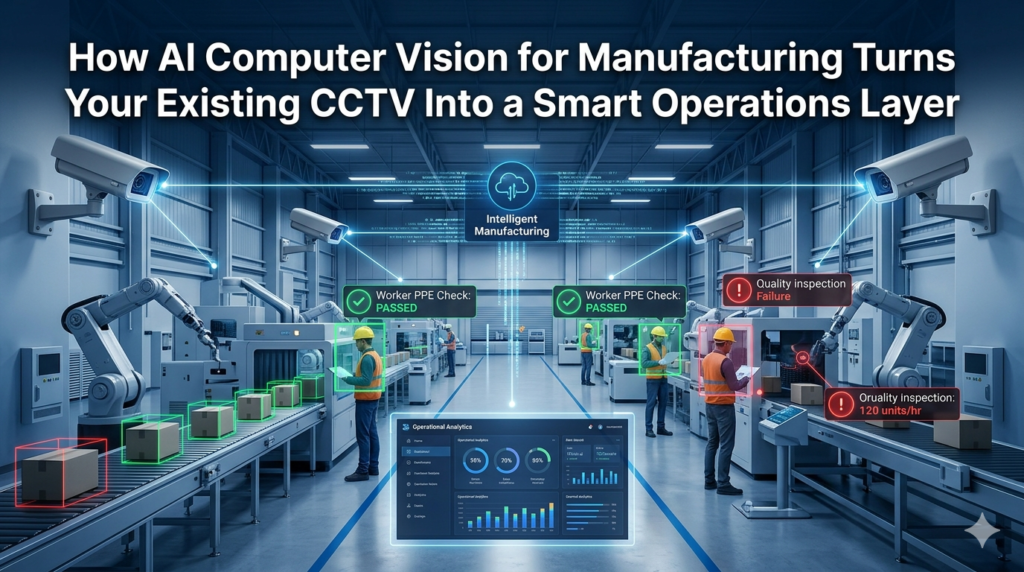
Most manufacturing facilities in India already have CCTV installed. The cameras are running, the feeds are recording, and yet incidents keep happening. Not because the cameras aren’t there, but because AI computer vision for manufacturing is still the missing piece. Traditional CCTV records. It doesn’t think. It doesn’t flag. It doesn’t alert.
Snoh Vision changes that. It layers intelligence onto your existing camera infrastructure — turning passive surveillance into an active, real-time operations tool — without requiring you to replace a single camera.
The Problem With Traditional CCTV in Industrial Settings
CCTV in most factories was designed for one purpose: post-incident review. Something goes wrong, you pull the footage, you see what happened. That model made sense in a different era. Today, it’s not enough.
Here’s what standard CCTV cannot do on its own: Watch all feeds simultaneously. A facility with 40 cameras would require 40 people staring at screens all day. That’s not feasible — so most feeds go unmonitored in real time.
Alert you when something goes wrong. Unless a human is actively watching the right feed at the right moment, violations and anomalies go undetected.
Work proactively. Footage is reviewed after an incident — after the injury, after the defect ships, after the unauthorised access. The damage is already done.
Generate usable data. Hours of video sit on a server as passive storage. No patterns, no trends, no insights.
Support compliance without manual effort. Safety audits and regulatory reviews require someone to physically review footage — an extremely time-consuming process.
The gap between having smart CCTV for factories and having the standard variety is not a hardware gap. It’s an intelligence gap. And that’s exactly what AI addresses.
What AI Computer Vision Actually Does (In Plain English)
You don’t need a computer science background to understand how this works. Here’s the plain-English version.
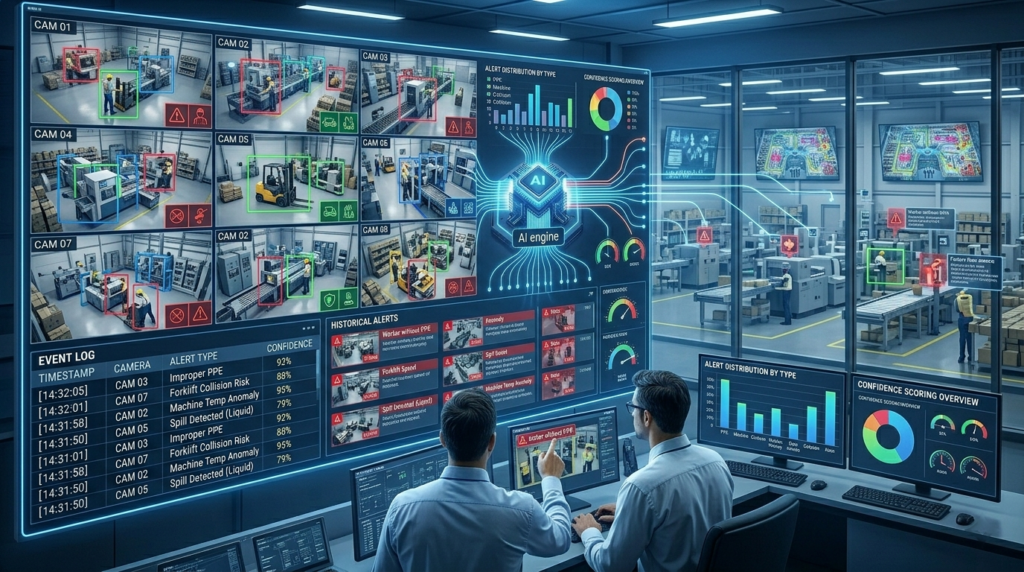
AI vision systems are trained to recognise specific things in a video feed — objects, people, behaviours, and anomalies. Think of it like a very attentive, very fast observer who has studied thousands of examples of “what normal looks like” and “what a problem looks like.” Once trained, the system watches every camera, every second — continuously — which is something no human team can physically do.
When the system spots something that matches a defined alert condition (a worker without PPE, a defect on a product, an unusual machine vibration pattern visible on camera), it raises an alert immediately. It also logs the event with a timestamp, the camera ID, and a snapshot of the moment — creating an automatic audit trail without any manual effort.
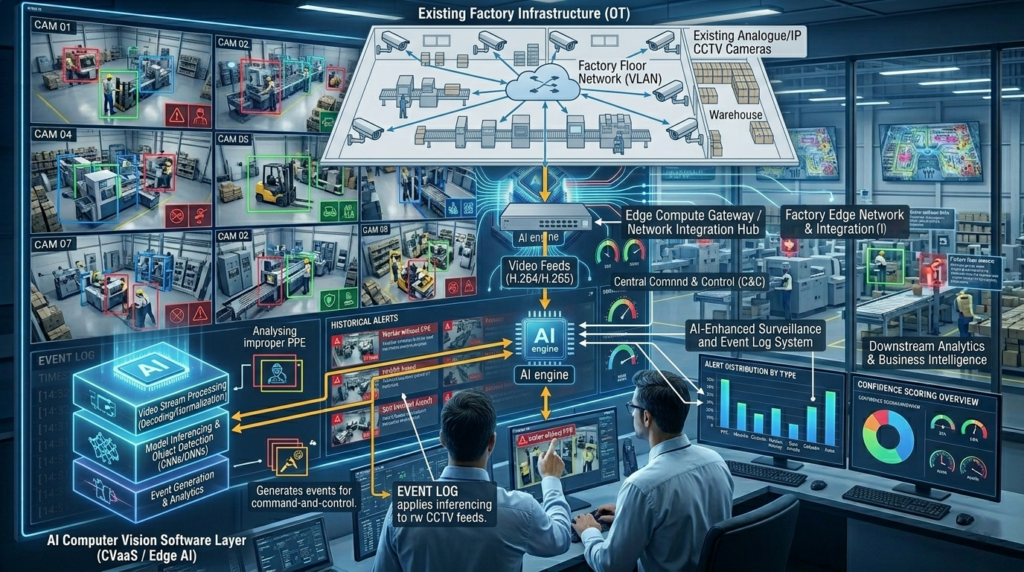
What makes this practical for Indian manufacturers is that AI-powered video surveillance in India doesn’t require ripping out your existing infrastructure.
Snoh Vision, SnohAI’s computer vision product, is designed to work with standard IP cameras and most common CCTV setups already in place at industrial facilities. You’re adding a brain to what you already have — not starting from scratch.
Three Ways Snoh Vision Creates Value on the Factory Floor
Quality Control Without Adding Headcount
Human inspectors are good. But they get tired. They blink. At line speeds of several hundred units per hour, catching every surface defect, label misalignment, or packaging error is genuinely difficult — especially at shift change when attention drifts.
Computer vision quality control doesn’t get tired. It watches the production line in real time, frame by frame, and flags anomalies the moment they appear. This includes: Surface defects: cracks, dents, discolouration, irregular edges Packaging errors: wrong labels, missing inserts, seal failures Dimensional mismatches: components that are visibly out of spec The result is a lower defect escape rate — fewer complaints from customers, fewer costly returns, and less rework downstream. More importantly, quality issues get caught at the source, not three stages later when they’re harder and more expensive to fix.
You’re not replacing your quality team. You’re giving them a tool that catches what they physically cannot.
Workplace Safety Monitoring — Before an Incident Happens
Every factory floor has a set of safety rules. Helmets in this zone. High-vis vests on the warehouse floor. No pedestrians past this point. No blocked emergency exits.
The challenge is enforcement. With hundreds of workers across a large facility, a safety officer cannot physically be everywhere. Violations happen, and they often go uncorrected until after something goes wrong.
Workplace safety monitoring AI changes the dynamic from reactive to preventive. Snoh Vision can be configured to detect: PPE violations: missing helmets, vests, gloves, or footwear Workers entering restricted or hazardous zones Vehicles — forklifts, trolleys — crossing into pedestrian areas Blocked emergency exits or fire suppression equipment When a violation is detected, the system sends an immediate alert to the relevant supervisor — not a weekly report, not a post-incident note, but an alert in the moment when action can still prevent harm.
According to data from the Directorate General Factory Advice Service & Labour Institutes (DGFASLI), thousands of workplace accidents are reported in Indian factories annually — many of which are preventable through timely intervention. Compliance with PPE requirements under the Factories Act, 1948 is a legal obligation, and AI-assisted monitoring helps EHS officers demonstrate that obligation is being met — with timestamped evidence automatically generated for every violation detected.
Real-Time Operations Intelligence
Beyond safety and quality, your cameras can tell you a great deal about how your operations are actually running — if something is listening.
Snoh Vision can monitor: Equipment anomalies: Visible signs of issues — smoke, unusual movement, idle machinery during peak hours — flagged before they become breakdowns Throughput visibility: Tracking movement at key production checkpoints to give supervisors a live picture of output rates Bottleneck identification: Watching where work piles up between stations reveals process inefficiencies that are invisible in aggregate data This is what real-time operations monitoring software looks like when it’s built on your existing camera infrastructure — not a new sensor network, not a separate IoT rollout.
When Snoh Vision detects an anomaly or threshold breach, those alerts can trigger automated workflows directly. If you’re already using Snoh Flow for process automation, an alert from the vision layer can automatically initiate a maintenance ticket, notify the right team, or escalate based on severity — without manual intervention.
Does This Work With My Existing Camera Setup?
This is usually the first question. And the honest answer is: in most cases, yes.
Snoh Vision is built to integrate with standard IP cameras — the type that makes up the majority of industrial CCTV installations in India. As long as your cameras produce a standard video stream (RTSP is the most common protocol), the AI layer can connect to them without hardware replacement.
What you do need: A reliable network connection between cameras and the processing layer Sufficient compute resources — either on-premise hardware or cloud connectivity A clear definition of what use cases you want to deploy first (quality, safety, operations) On the question of deployment model, Snoh Vision supports both cloud and on-premise options. For Indian manufacturers handling sensitive production data — proprietary processes, batch records, client specifications — on-premise deployment means video data never leaves your facility. This addresses the data sovereignty concern that many operations heads rightly raise before adopting any AI system.
No rip-and-replace. No six-month infrastructure project. Most deployments go live in four to six weeks for a defined use case.
Who Is Already Using This — And What Results Look Like
Manufacturing
Assembly line manufacturers are deploying computer vision primarily for two purposes: defect detection at speed and PPE compliance on the floor. A mid-size auto components facility, for instance, can use the same camera feed for both quality inspection and safety monitoring — two use cases, one infrastructure investment.
Warehousing & Logistics
In large warehouses and distribution centres, the priorities shift to access control, loading bay safety, and inventory movement visibility. AI vision flags unauthorised entry into restricted storage areas, monitors vehicle-pedestrian interaction at loading bays, and tracks the movement of goods through the facility — providing an operations picture that manual supervision cannot.
Pharmaceuticals & Food Processing
These sectors carry strict hygiene and contamination-risk obligations. Computer vision can detect hygiene compliance violations — no hairnets, improper handling procedures, contamination-risk events — in real time, supporting both internal quality standards and regulatory audits. In sectors where a single compliance failure can trigger a costly product recall, the prevention value is significant.
These three sectors represent the fastest-growing areas of AI adoption in Indian manufacturing in 2026. According to NASSCOM’s industry research, Indian enterprises are accelerating investment in operational intelligence tools as supply chain pressures and quality expectations from global clients intensify.
Common Questions Before Getting Started
Do we need to replace our cameras? Usually no. Snoh Vision works with most standard IP cameras already installed in industrial facilities. During the initial assessment, we identify whether your existing setup is compatible — and in most cases, it is.
How long does implementation take? For a defined use case — say, PPE monitoring on the main assembly floor — most deployments are live within four to six weeks. Broader rollouts across multiple use cases or sites take longer, but the deployment model is modular: start with one area, demonstrate value, then expand.
What about data privacy and storage? Video data can be processed entirely on-premise, meaning footage never leaves your facility. The system logs events — timestamped snapshots with context — rather than archiving continuous footage indefinitely. This keeps storage requirements manageable and data handling auditable.
Can it be customised for our specific process? Yes. The AI models are trained on your specific environment — your products, your facility layout, your safety rules. A standard helmet detection model works well out of the box, but customisation means the system learns what your line looks like and flags anomalies specific to your process, not a generic factory template.
Conclusion
Your cameras are already watching. They’re running right now — recording shift changes, production lines, loading bays, and access points. The gap isn’t coverage. It’s comprehension.
Snoh Vision adds the intelligence layer that turns passive recording into active operations management: catching quality defects before they ship, flagging safety violations before they become incidents, and surfacing operational bottlenecks before they cost you throughput.
If you manage a factory floor, warehouse, or production facility and want to understand what your existing cameras are currently missing, Snoh Vision is worth a conversation. The infrastructure is already in place. The question is whether you’re getting any value from it beyond storage.
SnohAI’s intelligent automation platform connects computer vision, workflow automation, and document management into a single operational intelligence stack — built for Indian manufacturing and logistics.
| Capability | Traditional CCTV | Snoh Vision (AI-Powered) |
| Real-time monitoring | Requires human watching feeds | Automated, 24/7 across all cameras |
| Alert speed | Post-incident (if reviewed) | Immediate, at moment of detection |
| Data generated | Raw video storage only | Timestamped event logs with snapshots |
| Human effort required | High — manual review for compliance | Automatic audit trail, always available |
| Compliance support | Manual footage review per audit | Automatic audit trail, always available |
| Quality detection | Not applicable | Real-time defect and anomaly flagging |
| Customisability | None | Trained to your products, layout, and safety rules |