
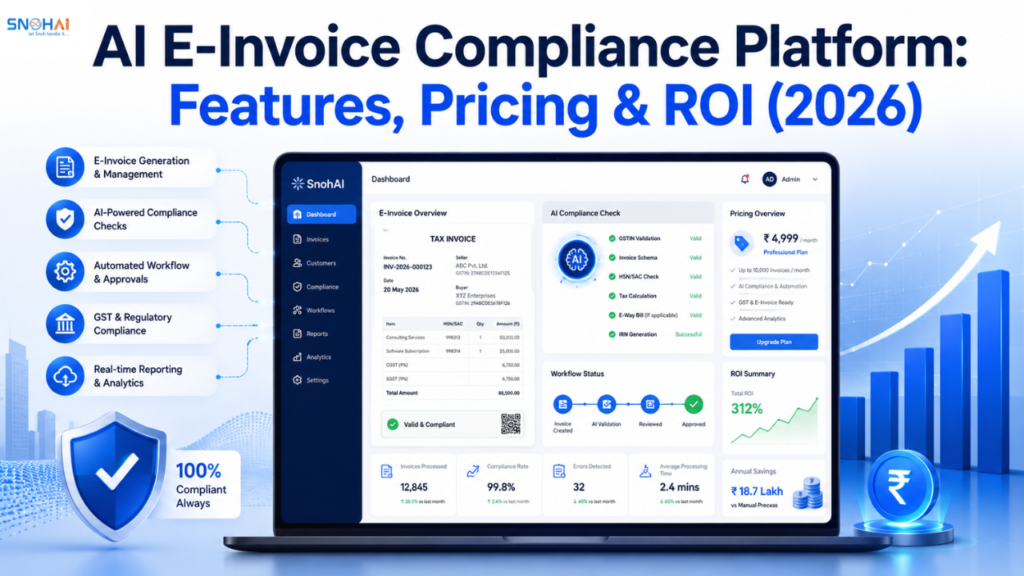
If your finance team is still emailing PDF invoices to suppliers or customers in a country with an active e-invoicing mandate, you’re already out of compliance — and the penalties are real. This guide breaks down what an AI e-invoice compliance software platform actually does, what it costs, and how to calculate the ROI before you sign a contract.
What Is an AI E-Invoice Compliance Platform?
An AI e-invoice compliance platform is software that extracts, validates, formats, and transmits invoice data in the structured, machine-readable formats (XML, UBL, Factur-X, JSON) that tax authorities now require, instead of relying on PDFs or manual re-keying.
Unlike a basic accounting add-on, these platforms use AI/ML and natural language processing to:
- Read unstructured or semi-structured invoices (PDF, scanned image, email) and extract line-item data with high accuracy
- Validate that data against the specific schema and business rules of each jurisdiction (e.g., India’s GST e-invoicing IRN generation, Poland’s KSeF, ZATCA’s Fatoora in Saudi Arabia)
- Route invoices through the correct clearance or reporting model — pre-clearance, real-time reporting, or decentralized exchange via Peppol
- Flag exceptions (mismatched tax codes, missing fields, duplicate invoices) before submission rather than after rejection
This matters because more than 80 countries no longer accept unstructured PDF invoices for B2B transactions in scope, and clearance-model mandates like Poland’s KSeF or Italy’s SdI treat a failed validation as a blocked transaction, not just a paperwork problem.
Why E-Invoice Compliance Became Urgent in 2026
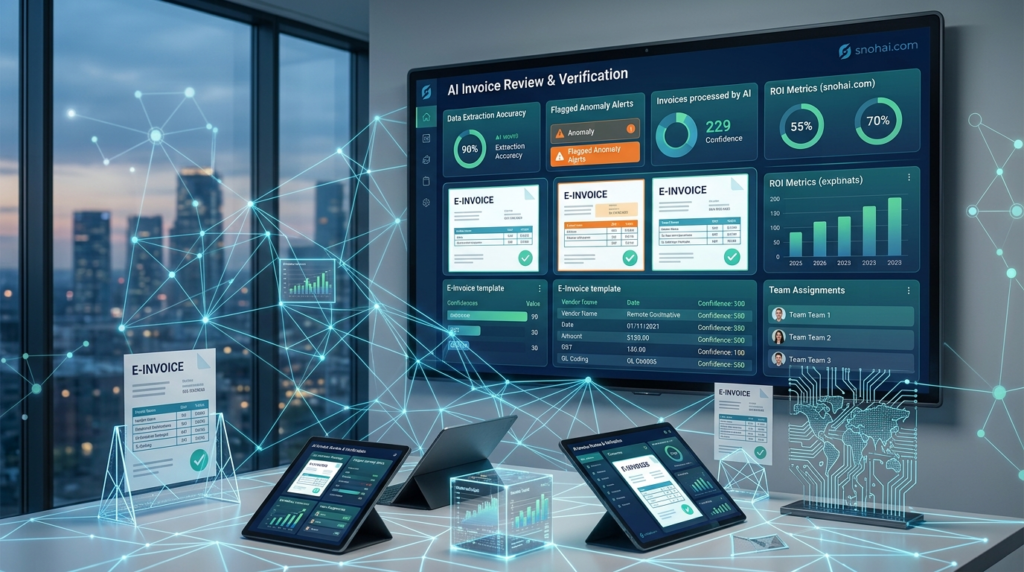
2026 is the year the largest wave of global e-invoicing mandates takes effect. Belgium’s B2B mandate went live in January 2026, Poland’s KSeF became mandatory for large businesses in February, and France begins its phased rollout for large and mid-sized enterprises in September 2026. Mandates are also active or expanding in Italy, Saudi Arabia, and India, with the UAE, Oman, and several Latin American markets adding new requirements through the year.
The regulatory logic is consistent across jurisdictions: governments want real-time or near-real-time visibility into B2B transactions to close VAT/GST gaps and reduce fraud. The European Commission’s VAT in the Digital Age initiative is the clearest example — it’s pushing intra-EU digital reporting toward mandatory status by 2030, and national mandates like France’s and Belgium’s are the on-ramp to that framework.
For finance and IT leaders, this means compliance is no longer a once-a-year audit concern. It’s a transaction-level requirement that has to be built into daily invoicing workflows.
Common Compliance Models You’ll Encounter
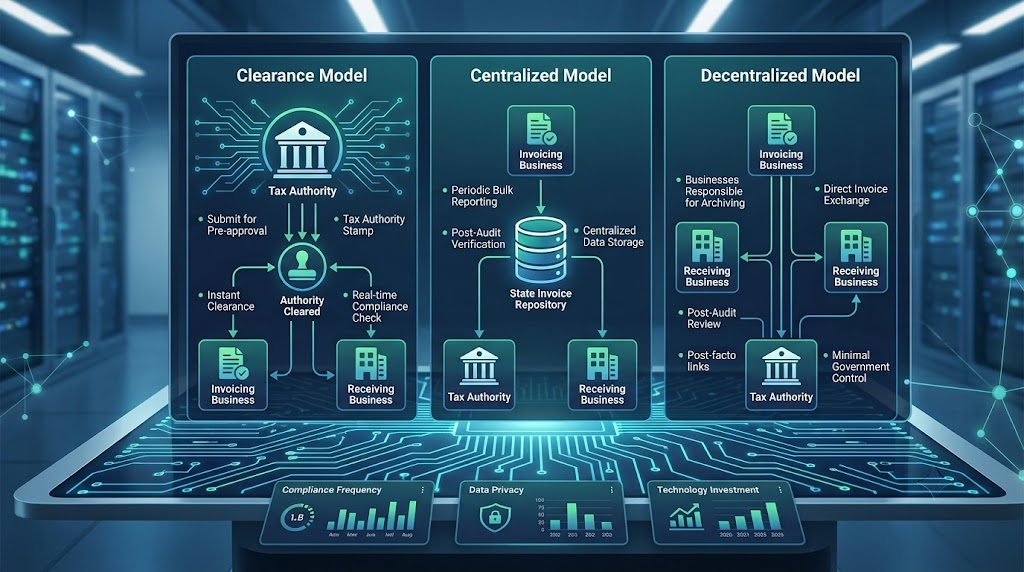
| Model | How it works | Example markets |
| Clearance | Government validates and issues a reference number before the invoice is legally valid | India (GST IRN), Italy (SdI), Saudi Arabia (ZATCA) |
| Centralized platform | Invoices submitted through a national portal | Poland (KSeF) |
| Decentralized exchange (Peppol) | Businesses connect once to an access point and exchange with any registered receiver | Belgium, Singapore (InvoiceNow), UAE (PINT AE) |
| Post-audit | Invoices exchanged directly; authorities review after the fact | Historically common in the US and parts of Western Europe, now shrinking |
Knowing which model applies to your invoicing volume by country is the first step before evaluating any platform — the technical integration differs significantly between a clearance mandate and a Peppol-based decentralized one.
Core Features to Look For
Not every “e-invoicing tool” actually solves compliance. Here’s what a genuinely capable AI platform should include:
- Structured data extraction — AI/ML-based extraction that turns invoices, purchase orders, and supporting documents into clean, structured data, regardless of source format. This is the foundation everything else depends on.
- Multi-jurisdiction schema validation — built-in rule sets for the specific countries you operate in, updated as mandates change (and they change often, as several 2026 deadlines have already shown).
- Automated routing and approvals — invoices shouldn’t just be validated; they need to move through approval chains with SLA/turnaround-time tracking so compliance doesn’t create a new bottleneck.
- Exception handling — a way to catch and resolve mismatched tax codes, missing mandatory fields, or duplicate submissions before they cause a rejected clearance.
- Audit trail and archiving — most mandates require structured invoices to be retained for several years (seven, in some EU jurisdictions), with full metadata.
- ERP integration — native connectors or APIs into your existing ERP/accounting stack, since most ERP e-invoicing modules only cover one or two countries out of the box.
This is where document intelligence and workflow automation need to work together. SnohAI’s Snoh Fusion handles the extraction layer — turning invoices, contracts, and tenders into structured, validated data using AI/ML/NLP — while Snoh Flow manages the approval routing and SLA/TAT monitoring that keeps compliant invoices moving instead of sitting in a queue. For teams that also need searchable, version-controlled storage of the underlying documents, Snoh Docs adds OCR-based document management on top.
If you’re still deciding between a narrower OCR tool and a full intelligent document processing (IDP) platform, our breakdown of OCR vs. IDP for invoice processing is a useful next read.
Pricing Models: What Determines Cost
AI e-invoice compliance platforms are usually priced one of three ways:
- Per-invoice/transaction pricing — you pay a fee per invoice processed or transmitted. This scales naturally with volume but can get expensive fast for high-volume AP/AR teams.
- Tiered subscription plans — a monthly or annual fee based on invoice volume bands, user seats, or number of connected jurisdictions. Predictable, but you may pay for headroom you don’t use.
- Enterprise/volume licensing — custom pricing for large organizations processing tens of thousands of invoices monthly, usually bundled with dedicated integration support and multi-country compliance updates.
Three factors move the price up or down regardless of model: the number of countries/jurisdictions you need covered, whether you need real-time ERP integration versus batch upload, and whether the vendor manages ongoing compliance rule updates for you or leaves that to your team.
Calculating ROI: The Three Levers That Matter
According to McKinsey’s research on finance function automation, document-heavy, rules-based processes like invoicing are among the highest-value targets for AI-driven automation because the labor cost of manual processing scales linearly with volume while automated processing does not.
When you model ROI for an e-invoice compliance platform, look at three levers:
- Labor cost avoided — hours saved per invoice on manual data entry, matching, and correction. Multiply by your monthly invoice volume and average AP staff hourly cost.
- Cycle time improvement — faster validation and approval means shorter days-payable-outstanding (DPO) and, in many markets, eligibility for early-payment discounts.
- Penalty and rework avoidance — rejected or non-compliant invoices in clearance-model countries block the underlying transaction. Factor in the cost of delayed revenue recognition or blocked payments, not just the direct fine.
A simple way to frame it for a finance stakeholder: if your team processes 5,000 invoices a month and manual handling costs even $2–3 per invoice in labor and error correction, automation that cuts that by 70% pays for a mid-tier platform subscription within the first two or three months — before counting avoided penalties at all.
Build vs. Buy vs. Platform: A Quick Comparison
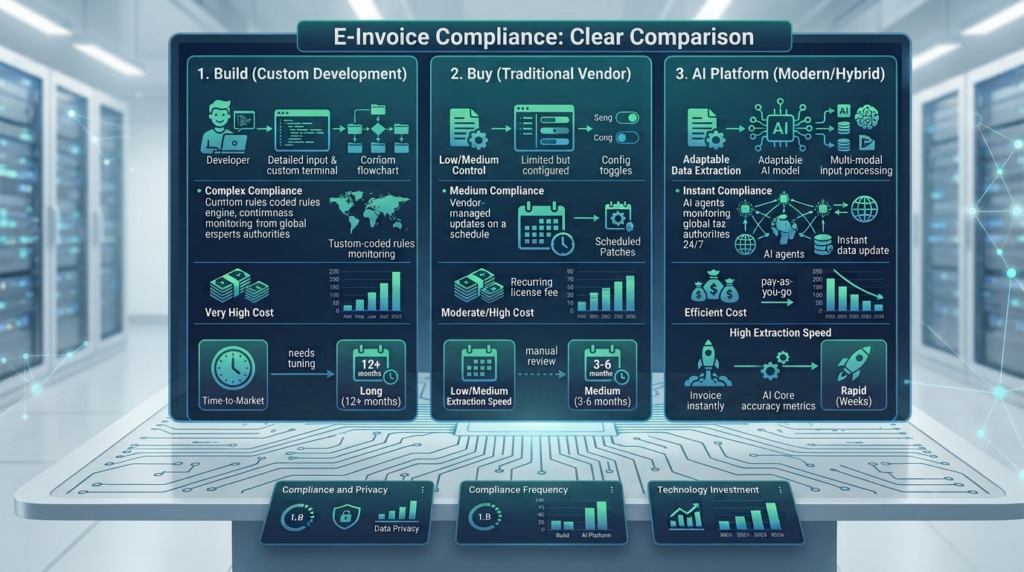
| Approach | Setup effort | Multi-country coverage | Ongoing compliance updates | Best for |
| In-house scripts/manual process | Low upfront, high ongoing | Poor — breaks with each new mandate | Your team’s responsibility | Very low invoice volume, single jurisdiction |
| Point solution (single-country tool) | Moderate | Limited to 1–2 countries | Vendor-managed for that country only | Businesses operating in one mandate jurisdiction |
| AI-driven IDP + workflow platform | Moderate, ERP-integrated | Scales across jurisdictions with rule updates | Vendor-managed, centrally updated | Mid-sized to large enterprises with multi-country exposure |
For a deeper look at platform options specifically sized for mid-market teams, see our guide to IDP tools for mid-sized businesses, and our broader roundup of intelligent document processing platforms.
How to Evaluate a Vendor Before You Commit
Ask any shortlisted vendor these four questions:
- Which specific countries and compliance models (clearance, centralized, decentralized) does your platform support natively, and which require a third-party add-on?
- How is invoice data extracted — is it template-based OCR, or AI/ML-based extraction that handles varied formats and layouts?
- How are compliance rule changes handled when a government updates its schema or deadline mid-year?
- What does the exception-handling workflow look like when an invoice fails validation — does it route back to a human reviewer with context, or just bounce with an error code?
If a vendor can’t answer the second and third questions clearly, you’re likely looking at a rules-based tool that will need constant manual maintenance as mandates evolve — which defeats the purpose of automation.
Ready to see how AI-driven document intelligence and workflow automation handle e-invoice compliance in practice? Start a free trial or explore Snoh Fusion to see how invoice extraction and validation work for your specific jurisdictions.
FAQ
What is e-invoice compliance software?
An AI e-invoice compliance platform extracts, validates, and transmits invoice data in the structured digital formats required by tax authorities, replacing manual PDF-based invoicing. It ensures invoices meet the schema, field, and transmission requirements of each jurisdiction where a business operates.
Which countries require mandatory e-invoicing in 2026?
E-invoicing mandates are active or launching in 2026 in Belgium, Poland, France, Italy, Saudi Arabia, India, and a growing list of Latin American, Middle Eastern, and Asia-Pacific markets. Coverage and deadlines vary significantly by country, so businesses should verify requirements for each jurisdiction where they operate.
Is a PDF invoice still legally valid?
In most mandate countries, no — a PDF has no legal standing as an invoice once a structured e-invoicing mandate is in force. Tax authorities require machine-readable formats like XML, UBL, or Factur-X, often validated through digital systems. An AI e-invoice compliance platform helps automate this validation process.
How much does AI e-invoicing compliance software cost?
Pricing typically falls into per-invoice fees, tiered subscription plans based on volume, or custom enterprise licensing for high-volume organizations. Cost depends heavily on how many jurisdictions you need covered and whether real-time ERP integration is required.
What’s the difference between OCR and AI-based invoice extraction?
Traditional OCR reads text from a fixed template and struggles with varied invoice layouts, while AI-based extraction uses machine learning and NLP to accurately pull structured data from invoices regardless of format or source. This distinction matters directly for compliance, since inconsistent extraction leads to failed validations.
How quickly can a mid-sized business become compliant?
Most ERP configuration and supplier onboarding for e-invoicing takes three to six months, depending on the number of jurisdictions and the complexity of existing systems. Businesses with an upcoming deadline within that window should begin vendor evaluation immediately rather than waiting for enforcement to start.