
Introduction
Engineering, Procurement, and Construction (EPC) companies operate in one of the most complex business environments globally. They manage multi-hundred crore projects, coordinate across geographically dispersed teams, handle intricate vendor ecosystems, and navigate stringent government compliance requirements. Every decision—from bidding on a tender to releasing vendor payments—carries significant financial and reputational risk.
Yet, many large EPC organizations continue to rely on manual, email-based approval processes. At small scales, these workflows are manageable. But when you’re handling hundreds of tenders annually, managing dozens of simultaneous projects worth thousands of crores, and coordinating approvals across regional hierarchies, manual processes break down. The result: lost visibility, weak audit trails, budget overruns, delayed decision-making, and considerable compliance exposure.
This is the reality one of India’s largest EPC companies faced—until they implemented Snoh Flow.
Challenges Faced by EPC Companies
The company in question was experiencing critical operational and governance gaps:
No Historical Records for Tender Decisions
Tender evaluation involved multiple stakeholders across regions and business units. But there was no centralized system to record who reviewed a tender, what their recommendation was, or why the company decided to bid or pass. This created zero institutional memory and made it impossible to learn from past bidding decisions.
Unstructured EMD Submission Process
Earnest Money Deposit (EMD) submissions required approvals, but the process was ad hoc. There was no standardized workflow to ensure the right people reviewed and approved EMD commitments based on project size or region.
Inability to Set and Enforce Project Budgets
Even when a project was awarded at ₹100 crores, management wanted operational budgets capped at, say, ₹90 crores to ensure margin protection. But there was no system to enforce this cap during the procurement and payment approval stages. Budget overruns were discovered only during post-facto reviews.
Manual Purchase and Vendor Payment Approvals
Every purchase requisition and vendor payment went through email chains. Approvers had no context. There was no link between the approved project budget, the purchase request, and the eventual SAP transaction. Payments worth crores were approved without a complete audit trail.
Zero Accountability on Approvals
The biggest gap: no one could answer “who approved this?” with certainty. Decisions were made verbally, over calls, or via forwarded emails. When internal audits or compliance reviews occurred, the team spent weeks reconstructing decision trails—often unsuccessfully.
High Audit Effort and Compliance Risk
Internal audit teams faced an uphill battle. With no structured data, every audit was manual, time-consuming, and incomplete. Regulatory and contractual compliance became a constant source of anxiety.
The Need for a Workflow-Driven Approach
What the company needed was not just digitization—it was structured, governed, traceable workflows.
In EPC operations, decisions must follow hierarchies. A ₹10 lakh purchase in the North region may need approval from a Regional Manager, while a ₹5 crore purchase requires CFO sign-off. A tender in the infrastructure vertical may route differently than one in the energy vertical. And every decision—whether it’s a bid/no-bid call or a vendor payment—needs to be recorded with full context: who initiated it, who reviewed it, who approved it, and why.
This requires role-based approvals, dynamic routing based on business rules, and complete traceability. Email threads and spreadsheets cannot deliver this. A purpose-built workflow engine can.
Snoh Flow Solution Overview
Snoh Flow is a dynamic workflow and approval management platform designed for enterprises that need governance at scale. It allows organizations to design, deploy, and manage approval workflows across departments, business units, geographies, and hierarchies—without writing code.
Key Capabilities:
- Dynamic Workflow Creation: Workflows can be configured by department (Procurement, Finance, Projects), business unit, region (North, South, East, West), and hierarchy level.
- Role-Based Access Control: Every user is assigned a role—Initiator, Reviewer, or Approver—with clearly defined permissions.
- Conditional Routing: Approvals automatically route based on transaction value, project type, location, or any other business rule.
- Full Auditability: Every action is logged with timestamp, user ID, role, comments, and attachments.
- SAP Integration: Approved transactions seamlessly flow into SAP for PR creation, PO generation, and payment processing.
Snoh Flow doesn’t replace ERP systems like SAP—it complements them by adding a governance layer on top.
How Snoh Flow Works in the EPC Lifecycle
The EPC company deployed Snoh Flow across their entire project lifecycle. Here’s how it works in practice:
Tender Upload and Approval
When a tender opportunity arises, the business development team uploads it into Snoh Flow. Based on the tender value and region, the system automatically routes it to the relevant reviewers—Regional Head, Vertical Head, and CFO, depending on size. Each reviewer records their recommendation and rationale. The final approver makes a go/no-go decision, which is permanently recorded.
Recording Bid/No-Bid Decisions
Every tender decision is now traceable. If the company bids and wins, there’s a record. If they pass, the reason is documented. Over time, this builds institutional knowledge and improves bidding strategy.
EMD Submission Approvals
Once a bid decision is made, EMD submission follows a structured workflow. Finance reviews the funding requirement, senior management approves the commitment, and the records are stored for future reference.
Project Budget Setup and Enforcement
When a project is won, the Project Director sets up the budget in SNoh Flow—say ₹90 crores for a ₹100 crore contract. This budget becomes the control layer. Any purchase requisition that would breach this budget is automatically flagged and requires exception approval.
Requirement Approvals Linked to SAP PR
When the project team needs to procure materials or services, they raise a requirement in Snoh Flow. The workflow routes it through the Project Manager, Procurement Head, and Finance—based on value thresholds. Once approved, Snoh Flow triggers automatic PR creation in SAP, ensuring seamless handoff.
Vendor Payment Approvals
Vendor invoices are uploaded into Snoh Flow along with supporting documents. The system verifies them against approved POs, routes them for technical and financial approval, and only then allows payment processing in SAP. Every payment has a complete approval trail.
Government Contract Approvals
For contracts with government entities, compliance requirements are stricter. Snoh Flow ensures these contracts go through legal, compliance, and senior management review before execution—with complete documentation.
End-to-End Visibility
From the moment a tender is uploaded to the final payment realization, every step is visible in Snoh Flow. Dashboards show pending approvals, bottlenecks, and historical trends. Management gets real-time insights into project health and procurement efficiency.
SAP Integration
One of Snoh Flow’s most powerful features is its seamless integration with SAP.
Once a purchase requirement is approved in Snoh Flow, the system automatically creates a Purchase Requisition (PR) in SAP. The PR then follows the standard SAP procurement process—PR → PO → Goods Receipt → Invoice → Payment. But the governance and approval logic stays in Snoh Flow.
This separation is intentional. SAP handles transactions; Snoh Flow handles governance. Together, they provide both control and efficiency.
The integration ensures that no PR can be created in SAP without prior approval in Snoh Flow. This closes a major compliance gap and ensures that every rupee spent is pre-authorized and traceable.
Read More: SAP Integration
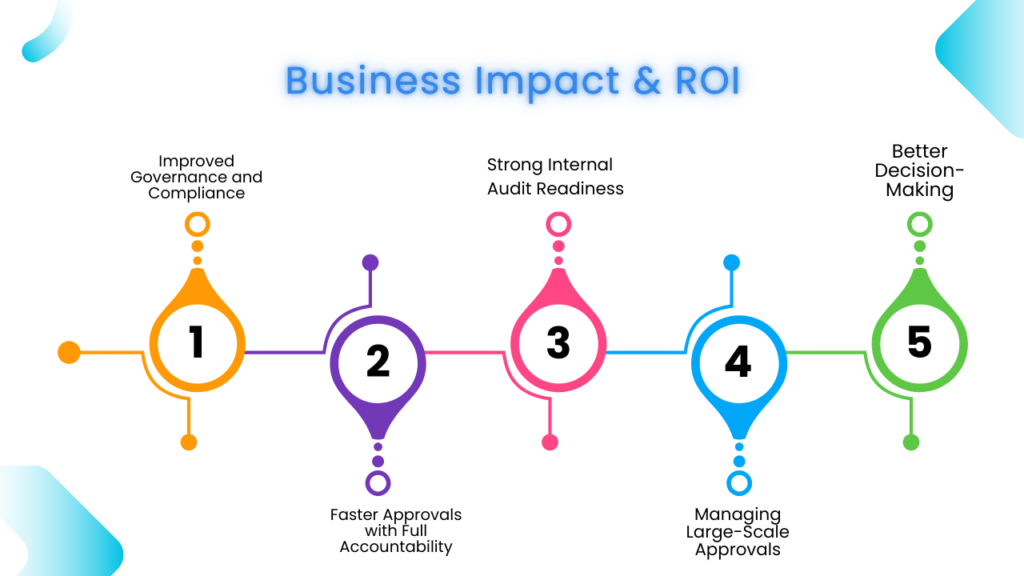
Business Impact & ROI
The results for the EPC company were transformative:
Improved Governance and Compliance
Every decision is now documented with full context. Internal audits that previously took weeks now take days. Compliance risk has dropped significantly.
Faster Approvals with Full Accountability
Approvals that used to take 5-7 days now complete in 1-2 days. But speed hasn’t compromised control—every approval is recorded and traceable.
Strong Internal Audit Readiness
Audit teams can now pull complete approval trails in minutes. They can see who approved what, when, and why—across thousands of transactions.
Managing Large-Scale Approvals
The company now processes approvals worth hundreds and thousands of crores annually through Snoh Flow. The system handles volume without breaking.
Better Decision-Making
With historical records available, decision-makers can refer to past projects, understand what worked, and make more informed choices.
Why Accountability Changes Decision Quality
One of the most underestimated benefits of Snoh Flow is psychological.
When approvers know their decisions are being recorded—with their name, role, and rationale—they think more carefully. Impulsive decisions decrease. Due diligence improves. Approvers ask better questions, request more documentation, and consider implications more thoroughly.
This isn’t about micromanagement. It’s about creating a culture of ownership. When people know they’ll be held accountable, they take accountability seriously. Over time, this shifts organizational behavior toward more thoughtful, defensible decision-making.
Conclusion
EPC companies operate in high-stakes environments where governance, compliance, and financial control are non-negotiable. Manual approval processes—no matter how well-intentioned—cannot scale to meet these demands.
Snoh Flow provides the digital backbone that modern EPC enterprises need. By bringing structure, visibility, and accountability to every approval—from tender evaluation to vendor payments—it transforms how these organizations operate.
For the EPC company in this case study, Snoh Flow didn’t just solve operational pain points. It fundamentally changed how decisions are made, recorded, and reviewed. It turned governance from a compliance burden into a competitive advantage.
In an industry where margins are thin and risks are high, that transformation is worth everything.